
Step into the world of the Siamese and Oriental cats & kittens. Please scroll down for the Siamese & Oriental cats history, characteristics, links plus details of Breeders.
This web site holds a source of information about a breed of cat that is renowned for its striking beauty, intelligence, and unforgettable personality. With vivid blue sapphire eyes, graceful elegant bodies and a ‘dog like’ affectionate nature, no wonder Siamese cats have captivated hearts for generations. These cats are not just beautiful companions but become devoted members of the family who thrive on human connection and companionship.
Here you’ll discover everything that makes the Siamese & Oriental breed so extraordinary from their rich history and unique characteristics to kitten development, care, showing, and breeding.
Whether you are a long-time admirer of this breed of cat, a proud owner, or you are searching for the perfect feline companion, this site is dedicated to sharing the charm, elegance, and loving spirit of these remarkable cats.


About Siamese cats & kittens
Siamese cats come in a variety of stunning point colours including seal, chocolate, blue and lilac along with some modern variations. Their short, fine coats are easy to maintain and highlight their elegant features beautifully.
A Siamese cat is intelligent, affectionate, and endlessly captivating.
Why People Love Siamese Cats
Striking sapphire-blue eyes
Elegant and athletic appearance
Loving and devoted personalities
Highly intelligent and interactive
Playful, social, and entertaining companions
Rich history and royal heritage
For many cat lovers, sharing life with a Siamese is not simply owning a pet: it is gaining a constant companion and cherished member of the family.
The HISTORY of Siamese cats

The Siamese cat, the national breed of Thailand is one of the most renowned and popular breeds of cat in the world today.
WHERE THOUGH DID IT COME FROM:
The Siamese cat is one of the most renowned and popular breeds of cat in the world today. With their distinct dark coloured points, beautiful almond shaped blue eyes and elegant, sleek bodies along with friendly, charming and sociable personalities they can make an ideal pet and companion.
One of the earliest manuscripts to mention a cat with the appearance of a Siamese is found in the ‘Tamra Maew’: the Cat Book Poems: a collection of ancient manuscripts from the Ayutthaya Kingdom (1351-1767 AD).
The author states that the breed is ‘pointed’, a reference to the distinct markings of darkened points: feet, tail, ears, and masked face. Within this sacred publication is asserted by the monks that the Siamese cat: ‘…. should be sought after as they would bring great honour and prosperity to their owner.’ Over a dozen of these manuscripts are now kept in the National Library of Thailand, the British Library and National Library of Australia.
Although the actual origin of the breed is difficult to prove, there are many stories mentioning that the first Siamese cats belonged to the Royal Family of Siam (now Thailand) and that the people of Siam believed their cats received their souls at death. These cats resided in the Temples and in the Royal Palace of Bangkok where they were closely guarded to keep the breed pure. At the time Siamese cats were used as guardians of the Temples and their blood lines were impeccably preserved. A Siamese cat was never sold and it was a great honour to be given one as a gift.
It was during the 19th Century, 1884 that a pair of these Royal Sacred Siamese or Seal Point (24) were given to the British Consul-General in Bangkok, Edward Blencowe Gould (1847–1916) by the King of Siam. The cat’s names were: Pho and Mai. He later gave them to his sister in England, Lilian Jane Gould, who in 1895 married and became Lilian Jane Veley. She formed the Siamese Cat Club in 1901, UK. In 1885, in England, Pho and Mia gave birth to three Siamese kittens: Duen Ngai, Kalohom, and Khromata. They were all shown at the first Cat Show at Crystal Palace in London the same year. Out of 480 entries in the show they became Best in Show winner.
With their unique appearance and distinct behaviour this new breed of cat created high interest but unfortunately all three of the kittens passed away shortly after the show although the cause of death remains unknown. This is the first known authentic record written about the Siamese cat that was in catalogues and journals. By the end of the 19th century the Siamese cat became well established in the UK, the number of these cats increased by breeding and imports from Bangkok.
As the popularity of the Siamese cat grew so did the enthusiasm for breeding this unique type of cat and this spread to America with two cats exported by Lady Marcus Beresford to Mrs Clinton Locke, the founder of the American Cat Fancy. These two seal point Siamese were exhibited at the Chicago Cat Show in 1902 taking out the Best in Show awards.
It was at the Holland House Cat Show in 1896 that the Judge: Louis Wain refused to judge a Siamese cat because it was blue and not seal as all Siamese up to then were seal. Very few Breeders at that time were interested in developing other colours although there were stories about ‘strange’ coloured kittens popping up in some litters. In the 1930’s a group of Breeders took up the challenge and in1936 the governing body granted the Blue Point Siamese its official number: 24A.
The chocolate point took longer to gain recognition with a male kitten born in 1931 being a much lighter seal colour although it wasn’t until 1950 that the Chocolate Point was officially recognised with the breed number 24B. The pioneer was Miss E Wentworth Fitzwilliam.
The Lilac Point 24C was produced by the combination of two genes: the blue and the chocolate dilutes. There are no records of how this fourth colour was developed although it had emerged by 1955 and was recognised by the Cat Fanciers Association (CFA) in the USA and known at the time as ‘frost points’.
In 1946 Mrs Hargraves commenced her ‘experimental’ breeding program and mated a seal point with a Russian blue with a further generation: Laurentide Mercury being born. Due to a controversy with this, a decision was made to have two Judges inspect Mercury with regards to his colour registration. Mercury was then placed on the supplementary register as a lilac point: with his progeny to be placed on a full register.
In the 1950’s and 1960’s, as the Siamese became extremely popular, many Breeders and Cat Show Judges began to favour the more slender, sleek type of look. As a result of selective breeding they created longer, fine-boned, narrow-headed cats which resulted in the modern show look of Siamese cat. A Siamese extremely elongated, with a lean, tubular body and long, slender legs plus a very long tail. The head wedge shaped with straight lines topped by extremely large, wide-set ears with the outline of the head and ears forming an equilateral triangle when viewed from the front. Neck long and slender.
By the mid 1980’s, cats of the original style had largely disappeared from Cat Shows but a few Breeders, particularly in the UK, continued to breed and register them, resulting in today's two types of Siamese: the modern, ‘show style’ Siamese, and the more ‘Traditional Siamese’ that are also known as ‘Old-style Siamese’, ‘Classic Siamese’, and ‘Apple head’.
The Siamese cat was also used to create other ‘man made’ breeds such as the Foreign White, the Oriental, the Burmese, the Balinese, the Himalayan Longhair, Ragdoll, Tonkinese, Snowshoe plus the Si Rex among others.

THE HISTORY OF THE SIAMESE CAT IN AUSTRALIA
The first official document states that two Siamese imports: two neutered seal points were sent by ship from the UK in 1902. The sea journey took nearly six months and both cats, sadly passed away shortly after reaching Sydney. It was in 1924 the first breeding pair of Siamese cats arrived, two seal points imported by Mr & Mrs Lonsdale of the Woodroffe Cattery. These two cats then became the foundation breeding stock for many Australian breeders.
The first Cat Club in Australia was established in NSW: the NSW Cat Fanciers Association (NSW CFA) and in 1925 they held their first show on a tennis court at Strathfield at the home of the Lonsdales.
Mrs Lynfae Rudder, their daughter became an all breeds Judge and a permanent member of the Royal Agricultural Society Consultative Committee (RASCC).
It was in NSW in 1949 that the Royal Agricultural Society Cat Club was formed and it became the central registering body for NSW. Up until 1950 the Royal Sacred seal point Siamese was the only colour recognised but then two Breeders: Mr & Mrs Hine imported a 24A (blue point) Velvet Mask Delphine and Kaybee Clematis from the UK.
Mr & Mrs Chandler in Victoria also imported a blue point: Misselfore Panella a male and Lela Do a female but sadly the male passed away. Timoshenko, a seal point male, that was bred from imported UK parents, proved to be carrying chocolate and Mrs Gabriella Kaufman in NSW produced Bluemead Suki and Polisson both 24B, chocolates.
As the blues and chocolates were now established in 1960 the lilac points followed with a lilac male: Annelida Lilac Nikomis and Supra Lollypop a lilac female were imported from the UK by Mrs Maloney and Mr Scott. Dr Pakham in Western Australia also bred these lilac colours.
Dame Nellie Melba, the famous Australian operatic soprano (1861-1931) apparently owned a pet seal point Siamese neuter.
MYTHS ABOUT THE SIAMESE CAT
The kinked tail (a cat’s tail with a bend in it) and crossed eyes that have now almost been bred out this breed were looked upon in ancient Siam (now Thailand) with great favour. These cats were used as guards in the ancient temples.
Ancient myths state that the Royal Princesses used the Siamese cat’s tail to keep their rings safe while bathing. The cat knotted their tail to prevent the precious jewellery from becoming lost.
Another myth states that during a fierce battle the Siamese temple cats were left to guard a valuable relic. The cats watched the relic so intently that their eyes became crossed. Some of the cats then wrapped their tails around the base of the relic to prevent it being stolen and their tails remained bent or kinked.
There is another myth that states that Siamese cats were used as ring holders by the Royal Princesses and that is how the kinks arose. At this time no one except the King and members of the Royal family were permitted to own one. Siamese cats at that time were said to have special powers.
The Siamese cat is renowned for its beautiful vivid blue eyes. There is a story about a group of invaders who came to rob the Temple where the cats resided. These invaders headed straight for the Temple’s altar where all the valuables were kept to rob the Temple of everything. When they reached the altar though, they found Siamese cats sitting on the altar steps. The cats glared ferociously at the invaders with fiery red eyes. The cats shown the invaders their sharp claws and teeth: the cats meowed loudly. The invaders then fled. When the monks returned to what they thought was going to be a ransacked Temple they found everything intact. The eyes of the cats all turned a brilliant sapphire blue which was thought to be a ‘thank you’ gift sent from heaven for saving the holy altar.
Siamese cats in ancient Siam were believed to avert evil spirits and the people believed a Siamese cat would bring good luck to their owner.
Siamese cats were said to defend the King of Siam. The cats apparently sat on tall columns around the throne and if anyone threatened the King or if the cats thought someone was a threat to the monarch, they would jump down and attack the person, knocking them to the ground and attacking them with their claws.
There is even a story about Noah’s Ark. During the long weeks of the voyage, Noah had already selected two of each of the animals for his Ark, and it was while they were waiting for the flood waters to subside that some of the animals got bored. A romantic ‘liaison' took place between a naughty monkey and a lioness.
This mating resulted in the arrival of the first Siamese cat which is said to have ‘the attributes of a monkey and the bravery of a lion’.
We can then see where the Siamese cat obtains its personality, playfulness, mischief and sheer ‘love’ for their owner. If you have never been greeted at the door after a ‘hard day at work’ by a Siamese cat then you will never understand what feline love is.
Siamese love human company and make wonderful companions. They will share your joys and sorrows, are devoted and loyal to their owners. Once you have owned a Siamese you will never really want to be without one.
References:
ACF Standards, 2021. https://www.acf.asn.au/notices/notices/standards/Group%20Two/2021_Group%202_Siamese.pdf
Bird, C: The Types of Siamese. https://web.archive.org/web/20060930012742/http://home.earthlink.net/~sarsenstone/threetypes.html
Boren, C: History of the Siamese. The Cat Fanciers’ Association Yearbook. Eatontown, NJ, 1959
Denlinger, M: The Complete Siamese Cat. Richmond, VA, 1952
Lauder, P. The Siamese Cat. Viking Press, 1979
Lauder, P: The Siamese Cat. Charles Schriber’s Sons. NY, 1979
The Portrait of the Siamese Cat. Cat Fanciers’ Federation. Gratis, OH, 2000
https://web.archive.org/web/20060810044400/http://www.cffinc.org/Siamese.PDF
White, B: We are Siamese, Yesterday, Today & Tomorrow. From the 1987-1988 CFA Yearbook. https://www.nationalsiamese.com
About Oriental cats

WHY I LOVE MY ORIENTAL CATS - Author: unknown
THE ENCHANTING ENIGMA OF THE ORIENTAL CAT
A shadow, a whisper, a creature carved from smoke and moonlight.
There exists a cat so otherworldly, so fine-boned and expressive, that one might believe it was conjured rather than born. The Oriental cat is that spectral being—grace wrapped in silk, eyes like verdant gemstones, and a voice like velvet thunder.
A BLOODLINE BORN IN MYSTERY
Though its roots reach back to ancient Siam (now Thailand), the Oriental is a more recent spell in the world of pedigree cats. Mid-20th-century breeders sought to capture the hypnotic elegance of the Siamese but clothe it in a thousand different cloaks—coal black, blood red, frost white, smoke grey. With over 300 colour and pattern combinations, the Oriental is a shape shifter, each one a singular vision.
This is not a breed that blends into the mundane. This is a cat that haunts your dreams.
A VOICE THAT ECHOES IN THE HALLS
The Oriental does not purr quietly in a corner. No, it announces itself—sharp, theatrical, sometimes accusing. It will hold conversations with the shadows, serenade the moon from the windowsill, and remind you (frequently) that you are not the master in this house—it is.
They bond deeply, obsessively, often choosing a favourite human to follow like a familiar. Alone time? The Oriental says no. Solitude is for mortals, not these celestial beings.
BEAUTY IN BONE AND SILHOUETTE
Their aesthetic is stark, angular, and arresting: a long, sinuous body, fine as a wisp of smoke. Ears rise like cathedral spires, wide and alert. Their eyes—most often a haunting green—glow with intelligence and secrets.
There is a short-haired version, sleek as shadow, and a long-haired variety whose coat flows like enchanted mist. Both are bewitching.
FOR THOSE WHO DARE
These cats are not mere pets. They are guardians of thresholds, watchers in the dark, muses to those who seek beauty with a blade of wildness. They require stimulation, affection, and conversation. Puzzle toys, feathered offerings, and high places to observe the world below are all essential.
They are known to thrive in homes where there is movement, energy, and above all—presence.
NOT FOR THE FAINT OF HEART
Orientals are emotional creatures. They feel deeply, love fiercely, and expect devotion in return. If ignored, they may unravel into anxiety or mischief. But if adored, they will wrap themselves around your soul and never let go.
TO SUMMON AN ORIENTAL INTO YOUR WORLD
Prepare a place where beauty and madness intertwine. Offer love, mystery, and soft velvet beds. Expect your days to be filled with conversation, your nights with silent watching, and your heart forever claimed by something other.
The HISTORY of Oriental cats

according to the CFA, ‘Orientals represent a diverse group of cats that have their foundation in the Siamese breed.’ The Siamese: both pointed (Siamese) and solid colours (Oriental) was imported to the UK from Siam (Thailand) in the latter half of the 1800s.
The Oriental Shorthair cat is an elegant breed of cat that come in a beautiful ‘rainbow’ mix of over 300 colour variations. You could say that they are a remake of the original ‘black and white’ Siamese.
Oriental cats are very intelligent, athletic and they love human company. When you are sitting down, an Oriental will be generally on your lap, and at night they will be in bed with you, probably under the covers with their head on your pillow.
The breed was originally developed with Siamese as the foundation stock and then crossing them with other breeds. The original intent was to broaden the Siamese gene pool in Britain because so many breeding programs had been devastated during World War II. Crosses were made with Russian Blues, British Shorthairs, and Abyssinians along with domestic shorthairs which resulted in kittens without the darker pointed Siamese pattern. These were then bred back to Siamese.
Within a few generations, Breeders managed to produce cats that looked like Siamese but with a variety of colours and coat patterns along with the traditional pointed pattern of seal, blue, lilac and chocolate points.
When the cats were imported into the United States in the 1970s, crosses with American Shorthairs produced yet more colours and patterns. A longhaired variety was also developed.
The Oriental has a smooth, silky coat lying close to the body that should be well muscled and supple. They should have a ‘triangular face’, wide-set ears, and long legs with a good length of tail. Most Orientals have green eyes, white Orientals can have blue or odd coloured eyes and the pointed oriental cats have blue eyes.
Note: according to the CFA, ‘Orientals represent a diverse group of cats that have their foundation in the Siamese breed.’ The Siamese: both pointed (Siamese) and solid colours (Oriental) was imported to the UK from Siam (Thailand) in the latter half of the 1800s, and from there spread widely, becoming one of the most popular breeds. The actual gene that causes the colour to be restricted to the points is a recessive gene; therefore the general population of the cats of Siam were largely self-coloured (solid). When the cats from Siam were bred, the pointed cats were eventually registered as Siamese, while the others were referred to as ‘non-blue eyed Siamese’ or ‘foreign shorthair’ e.g. hence the Oriental breed come back after WW2.
Agresta, Bob; Kultala, Joann (27 July 2010). ‘Oriental Breed Profile’ CFA Inc.Org.Cat Fanciers' Association
‘Information Regarding the Oriental Shorthair Cat’. Cuddly Kittens. 16 October 2011.
Complied from: Shiloh Siamese & Orientals
SIAMESE & ORIENTAL BREEDERS
This section lists Siamese and/or Oriental Breeders who breed 'pedigree' cats.
The inclusion in this listing does not indicate endorsement or recommendation. A reputable breeder will guarantee the initial health of the kitten, that it is free from genetic defects & diseases. It is a good idea to visit the Cattery in person. Most breeders breed for quality, not quantity which ensures the health and happiness of the Mother cat, as well as the kittens. Don't be surprised if there is a waiting list, and expect the average price for kittens to vary from breeder to breeder.
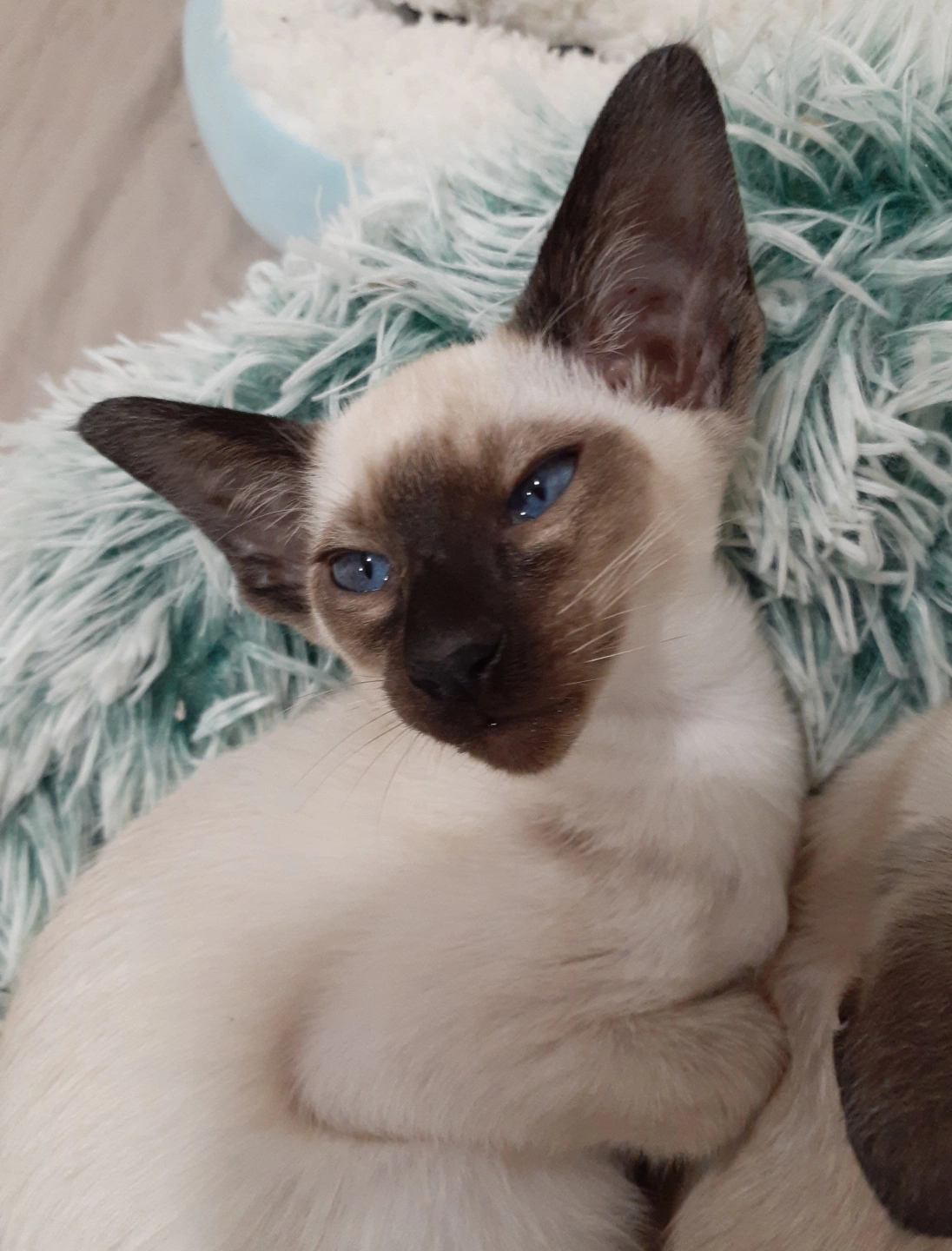
SHILOH Siamese & Orientals
Breeding only pedigree ‘pure’ & ‘specialised’ Siamese and Orientals.
Home of: CCCA Double Grand Champion & Gold Db Gd Ch plus Emerald Award of Excellence Diamond Db Gr Ch ASTRAXALOTTE AKONI GEM Blue Point Siamese from 'pure' Hawaiian bloodlines.
Registration: NSW CFA 59120
Face Book: https://www.facebook.com/shiloh.siamese/
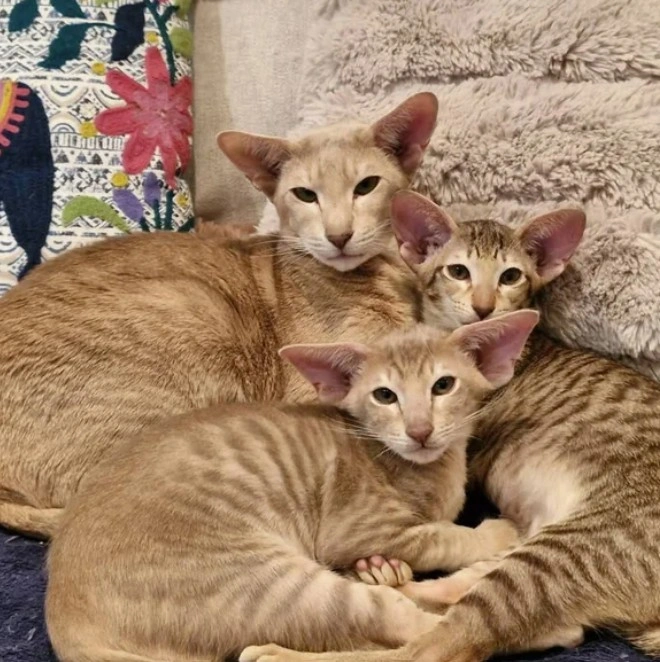
ZOEL Siamese & Orientals
Contact: Nikki James
Location: Northern Beaches
Registration: NSW CFA 125453
Home of the:
2023 Supreme Oriental, Attack's Love Actually, imported from Norway.
CALIAN Siamese & Orientals
Contact: Carolyn & Ian Harrison
Registration: NSW CFA 66510
ASHANTI Siamese & Orientals
Contact: Jeanie McConnell
Location: Macksville
Registration: ANCATS 12780
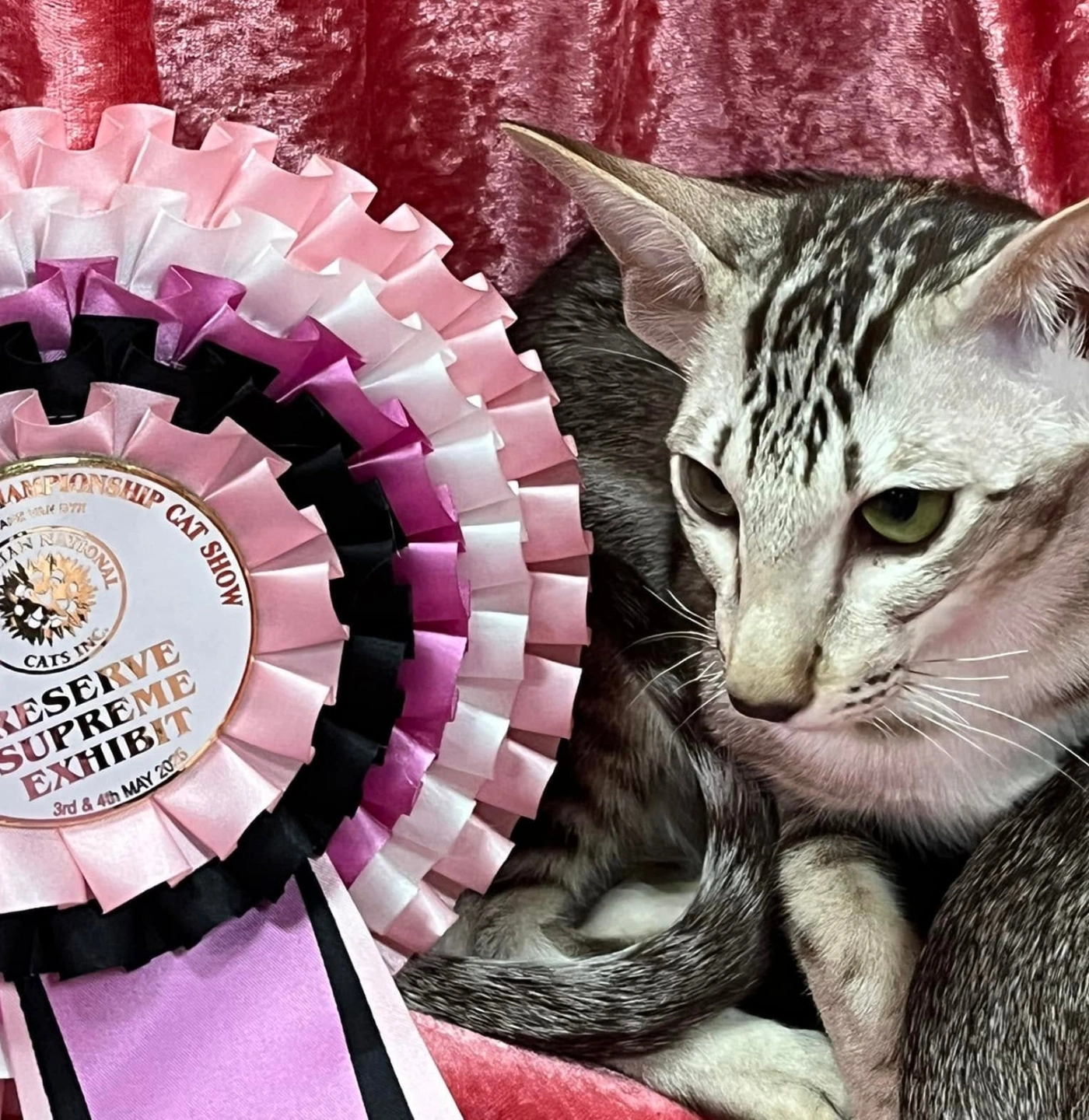
BAJIMBI Cats
Breeding award winning Siamese & Orientals along with Burmese.
Contact: Bambi Edwards
Location: Woolooware N.S.W.
Registration: ANCATS 1
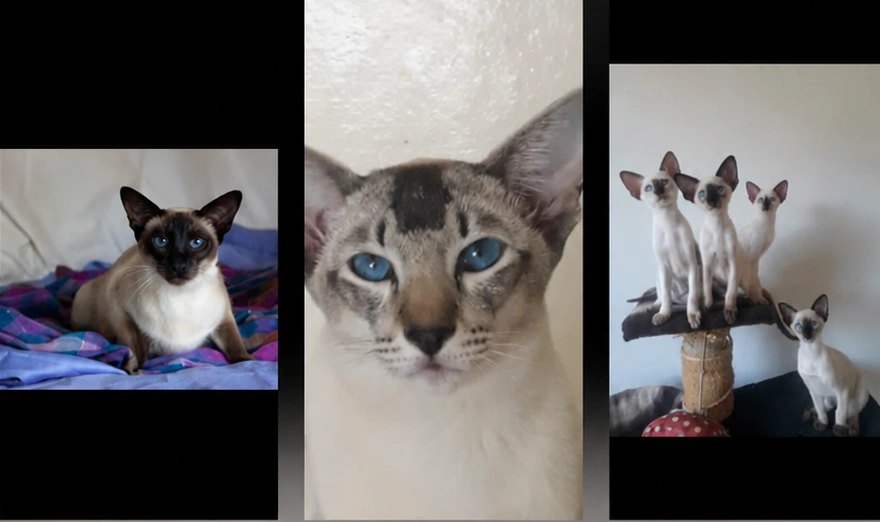
Naledi Siamese and Orientals
Breeding exquisite Siamese & Orientals in Bloemhof, South Africa.
Links for some of the major cat related organisations
This page provides individual links to websites of the major Cat Organisations.


Contact Us
Events
The Oriental Cat Club of NSW 'KIDS' Colouring in Contest.
To be judged at their Cat Show on: Saturday 5th September. Venue: St Ives Showground.
Entries can be handed in person at the Cat Show on the day or emailed to: shiloh.siamese@gmail.com
Two age categories: 4-8 yrs & 9-13 yrs.
Competition closes 5 Sept at 1:30pm. Further details and the entry form can be downloaded from the Oriental Cat Club of NSW Face Book page: https://www.facebook.com/OCCNSW